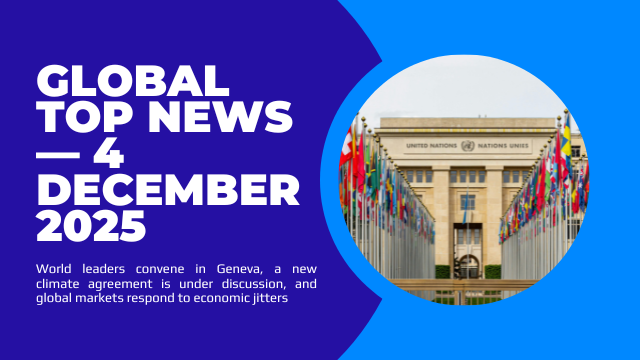
World leaders convene in Geneva, a new climate agreement is under discussion, and global markets respond to economic jitters.
Today’s international roundup: major powers meet in Geneva to discuss a new global accord, climate talks advance with a proposed cross-border carbon deal, and financial markets react sharply to signals of rising global interest rates.
Geneva / New York / London — 4 December 2025
World Powers Meet in Geneva — Toward a New Global Accord
Today, representatives from the world’s major powers — including the U.S., China, the European Union, and others — began a high-stakes summit in Geneva. The key agenda: negotiating a new global accord focused on trade regulations, digital governance, and peacekeeping commitments. Diplomats say the summit could reshape global trade rules and ease tensions over cybersecurity and digital data flow. Observers are watching closely: any breakthrough may significantly impact cross-border trade and international relations in the coming years.
Climate Talks Move Forward — Cross-Border Carbon Agreement Proposed
Simultaneously, global climate negotiations gained momentum as delegates from over 50 countries proposed a cross-border carbon credit and emissions-trading framework aimed at curbing greenhouse gas emissions more effectively. Under the proposed scheme, nations with high emissions could invest in carbon-offset projects in other countries — especially developing nations — to meet their climate targets under international agreements. Proponents argue this could accelerate global climate action, while some critics warn about enforcement loopholes and equity issues.
Markets Dip Amid Economic Jitters — Global Investors React
In financial markets, global stock and commodities indexes saw volatility today. Investors remain jittery after signals from major central banks indicating potential interest-rate hikes in early 2026. The uncertainty has triggered a wave of sell-offs in risk assets, especially in emerging markets, while safe-haven assets like gold and government bonds gained ground. Analysts caution that if inflation and economic slowdown fears persist, the coming months could remain turbulent for markets worldwide.
Why These Developments Matter
-
A new global accord on trade and digital governance could reshape how businesses and countries operate internationally, potentially setting updated standards for data, trade, and diplomacy.
-
The proposed cross-border carbon framework represents a shift toward shared global responsibility on climate — potentially allowing developing nations to benefit from climate investments, though governance and fairness remain critical.
-
Market turbulence reflects underlying global economic uncertainty. For countries like Bangladesh, shifts in global trade and capital flows can affect export demand, remittances, and foreign investments — making international developments relevant for our readers.